Britain runs on its railways. Every day, millions of us pass through a station on the way to work, on the way to an airport, or on the way to see family at the other end of the country. Some stations handle a few dozen passengers a year. Others handle almost a hundred million.
Every year, the Office of Rail and Road (ORR) publishes official estimates of station usage, showing exactly how many entries and exits each station in Great Britain records. It is one of the most revealing datasets in UK travel, and it tells you a great deal about how the country actually moves around.
The most recent figures cover April 2024 to March 2025 and were published on 4 December 2025. They show 1,730 million passenger journeys made across Great Britain in that year, an increase of 7 per cent on the 1,610 million recorded the year before, spread across 2,589 stations. Here is where all those people actually went.
Source: ORR, Estimates of Station Usage, April 2024 to March 2025
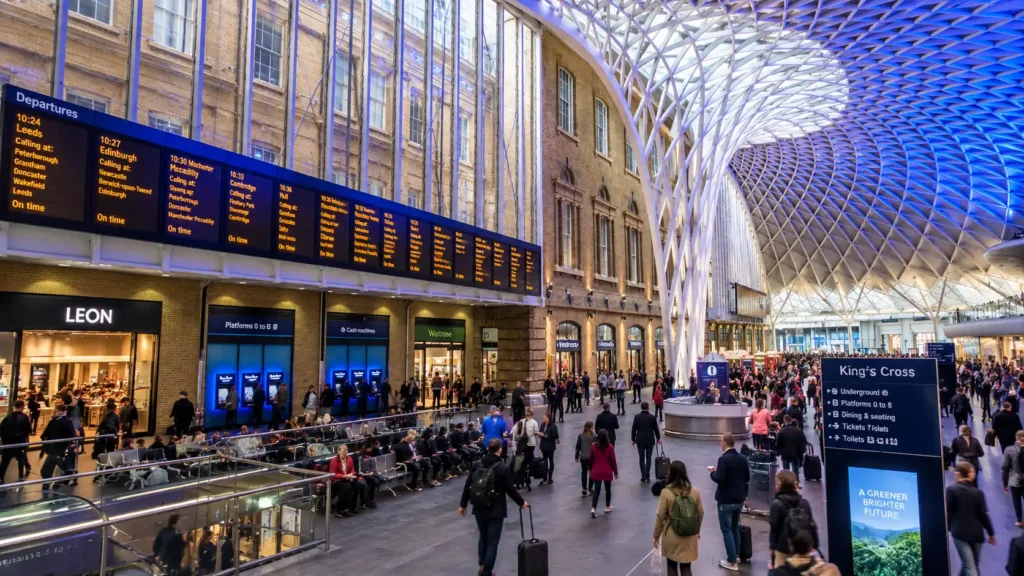
The Top 10 Busiest Train Stations in the UK
According to the latest ORR statistics, the top 10 busiest railway stations in Great Britain by entries and exits are:
1 – London Liverpool Street (98.0 million): Britain’s busiest station for the third year running, driven largely by Elizabeth line services.
2 – London Waterloo (70.4 million): The long-standing former number one, back up to second place this year.
3 – London Paddington (69.9 million): A major western gateway, and the home of both the Elizabeth line and the Heathrow Express.
4 – Tottenham Court Road (68.1 million): A relative newcomer to the top of the table, transformed by the Elizabeth line.
5 – London Bridge (54.7 million): London’s oldest railway terminus still in use, open since December 1836, and a huge commuter interchange.
6 – London Victoria (53.8 million): The main link to Gatwick Airport and the south coast.
7 – Stratford, London (51.5 million): East London’s principal interchange, serving several lines at once.
8 – Farringdon (50.2 million): A small station with an enormous footfall thanks to Thameslink and Elizabeth line connections.
9 – Bond Street (42.8 million): Central London shopping and business traffic, plus Elizabeth line passengers.
10 – London Euston (40.2 million): The southern end of the West Coast Main Line and the gateway to Birmingham, Manchester and Glasgow.
Source: ORR, Estimates of Station Usage 2024-25, published 4 December 2025
The pattern is immediately obvious. All ten of Britain’s busiest stations are in London. The capital does not simply lead the table, it occupies the entire table.

The Busiest Train Stations Outside London
Because London dominates the national list so heavily, the ORR also publishes a separate ranking for the rest of Great Britain. This is where the picture gets far more interesting, and far more relevant if you live outside the capital.
| Rank | Station | Entries and exits | Region |
|---|---|---|---|
| 1 | Birmingham New Street | 36.6 million | West Midlands |
| 2 | Manchester Piccadilly | 27.4 million | North West |
| 3 | Leeds | 27.3 million | Yorkshire |
| 4 | Glasgow Central | 25.3 million | Scotland |
| 5 | Edinburgh Waverley | 22.8 million | Scotland |
| 6 | Gatwick Airport | 21.2 million | South East |
| 7 | Brighton | 15.3 million | South East |
| 8 | Glasgow Queen Street | 15.0 million | Scotland |
| 9 | Liverpool Central | 14.8 million | North West |
| 10 | Liverpool Lime Street | 14.4 million | North West |
Source: ORR, top 10 most used stations outside London, April 2024 to March 2025
Birmingham New Street holds on comfortably at the top, and it is not a close contest. With 36.6 million entries and exits, it handles roughly nine million more passengers than Manchester Piccadilly in second place. As the busiest interchange outside London, New Street sits at the centre of the national network, which is exactly why so many journeys across the country pass through it, and why group transport across the West Midlands so often starts or ends there.
Leeds has moved up to third, overtaking Glasgow Central. Gatwick Airport station is the highest-placed airport station on the list, which is a useful reminder of how closely rail and air travel are tied together in the UK. If you are heading that way as a group, our Gatwick Airport transfer service takes the connection out of the equation entirely.

The Busiest Stations in Scotland and Wales
Glasgow Central remains Scotland’s busiest station with 25.3 million entries and exits, followed by Edinburgh Waverley with 22.8 million. Both have held their national rankings for years.
In Wales, Cardiff Central is comfortably the busiest station with 12.5 million entries and exits. Newport is second with 2.8 million, which shows just how concentrated Welsh rail traffic is around the capital.
Source: ORR, Estimates of Station Usage 2024-25
Why Are Train Stations So Busy?
Stations get busy for a mix of reasons. Some are permanent and structural. Others are temporary and seasonal, and they pile pressure onto an already crowded environment. Here are the main ones.
Daily commuting
The single biggest driver. Millions of people travel into city centres for work every weekday, and they nearly all do it within the same two narrow windows in the morning and late afternoon. That concentration is what creates the crush, not the total number of passengers.
Interchange traffic
Some stations are busy because of who passes through them rather than who starts or ends a journey there. Birmingham New Street, Stratford and Farringdon all handle enormous numbers of people simply changing trains.
The Elizabeth line effect
Since the central section opened on 24 May 2022, the Elizabeth line has completely reshaped travel across London. It is the main reason Liverpool Street, Paddington, Tottenham Court Road, Farringdon and Bond Street now sit so high in the national table. Six of the ten busiest journeys in Great Britain are now between stations served by the line, with 8.7 million of them running between Liverpool Street and Tottenham Court Road alone.
Airport and long-distance links
Stations that connect to airports or major intercity routes carry a very different kind of passenger, usually with luggage and a fixed deadline. Gatwick Airport, Paddington, Euston and Victoria all fall into this group, and luggage alone slows the flow of people through a station considerably. It is one of the reasons many groups skip the train entirely and book a direct airport transfer instead.
Events, holidays and seasonal peaks
Football matches, concerts, festivals and bank holiday weekends create sudden surges that stations were never designed to absorb evenly. A single large event can put tens of thousands of extra people through one station in the space of a couple of hours.
Engineering works and disruption
When a line closes for maintenance, or a service is cancelled, passengers do not disappear. They pile onto the next available train or crowd onto the concourse waiting for information. Planned engineering work around Christmas and Easter is a regular cause of overcrowding at major stations.

And the Quietest Stations in Great Britain
At the other end of the scale, some stations barely register at all. In the same year that Liverpool Street recorded 98 million entries and exits, the five least used stations in Great Britain were:
1 – Elton and Orston, Nottinghamshire: 68 entries and exits
2 – Shippea Hill, Cambridgeshire: 76
3 – Ince and Elton, Cheshire: 98
4 – Denton, Greater Manchester: 100
5 – Reddish South, Greater Manchester: 102
Source: ORR, least used stations in Great Britain, April 2024 to March 2025
To put that into perspective, London Liverpool Street handles more passengers in roughly 20 seconds than Elton and Orston does in an entire year.
The reason these stations stay so quiet is the timetable rather than the location. Elton and Orston is served by a single East Midlands Railway train in each direction from Monday to Saturday, with nothing at all on a Sunday. Shippea Hill is quieter still in one direction, with a westbound service that only runs on Saturdays. Closing a station outright requires a formal process, so a minimal service is often kept running instead, which keeps the station technically open without ever building any real demand.
A Note on the Figures
The ORR is clear that its estimates are drawn mainly from LENNON, the rail industry’s ticketing and revenue system, with adjustments applied to improve accuracy. The methodology is refined over time, so year-on-year comparisons are not always exact, and stations without ticket barriers are harder to measure than those with them. The rankings are reliable, but the precise numbers should be read as well-informed estimates rather than a turnstile count. You can read the full ORR announcement for the complete breakdown.
What This Means If You Are Travelling as a Group
Reading through the figures, one thing stands out. The busiest stations in the country are busiest at exactly the times most people need to use them, and that becomes a genuine problem when you are travelling with a group rather than on your own.
Getting eight, sixteen or fifty people through Birmingham New Street at half past five on a Friday, with luggage, is a very different proposition to doing it alone with a rucksack. Add a cancelled service or a rail replacement bus into the mix and a straightforward trip can unravel quickly.
This is where hiring a minibus or coach with a driver makes a real difference. Everyone travels together, everyone leaves from the same place at the same time, and nobody has to work out which platform the replacement service is departing from. There is no scramble for seats, no split group across two trains, and luggage simply goes in the boot. Because hire is priced per vehicle rather than per head, it also tends to compare better than people expect once you add up individual rail fares, and our guide to minibus and coach hire costs explains how that pricing works.
It is also worth remembering that the rail network is not always available. Strike days, planned engineering closures and severe weather all take services out of action, usually at the busiest times of year. Having a private vehicle booked removes that risk entirely.
If air travel is more your concern, our companion piece on the top 10 busiest airports in the UK covers the same ground from the departure lounge.
Travel Together with Travel SOS
At Travel SOS, we provide minibus and coach hire with professional drivers across Birmingham and the wider UK. Whether it is an airport transfer, a corporate away day, a school trip, a sporting event or a group heading off on holiday, we take care of the whole journey door to door.
Our vehicles range from standard minibuses through to executive coaches with reclining seats and on-board facilities, so we can match the vehicle to the size and style of your group. You get a fixed price agreed up front, with no hidden costs on arrival, and hundreds of five star reviews across Google, Facebook and Trustpilot behind us.
If you are planning a group journey and would rather skip the crowded concourse altogether, get in touch with our friendly team today for a quote, or call us on 0800 0096 505.